Reading Tenet in both directions
What changes when a film’s structure becomes part of its subject—and understanding arrives after the experience?
An illustrative sample essay for this site’s first edition; not a previously published essay by Staniel Makarov. Contains discussion of Tenet.
Some films become clearer as they move forward. Others rearrange what we thought we had already seen. Tenet makes that rearrangement one of its central pleasures. A gesture that first appears inexplicable can return with a different context, without changing its outward form.
This creates two kinds of viewing at once. We follow the immediate event, trying to understand what is happening. We also accumulate images whose meaning is deferred. The film asks memory to do work that exposition cannot entirely perform.
Before explanation
An unfamiliar action is not an absence of information. It can be rich in visual detail even when we cannot yet organize those details into a cause. Movement, rhythm, and position remain available to the eye before their significance becomes available to the mind.
That gap can be frustrating. It can also produce a distinctive form of attention. Instead of recognizing an action and moving on, we retain it as a problem. The image has not finished happening for us simply because the scene has ended.
In this sense, a later explanation does more than add information. It sends the viewer back. A first encounter and a later recognition become two parts of a single experience, separated by the time required to understand.
A structure we have to inhabit
The temptation is to draw a diagram and treat the diagram as the film’s final form. Diagrams are useful. They can clarify relationships, make a sequence legible, and expose a mistaken assumption. But they also remove the duration through which a viewer encounters the work.
A diagram presents its relations together. A film distributes them. To understand the structure is therefore not quite the same thing as understanding the experience of discovering that structure.
The distinction gives us a practical question for interpretation: why does this information arrive here? Asking only what happened can overlook the significance of when we become able to recognize it.
The square and the sequence
The Sator square offers a compact image of reading in multiple directions. Its arrangement is spatial; the eye can move across it in different ways. Cinema must make such relationships unfold through time.
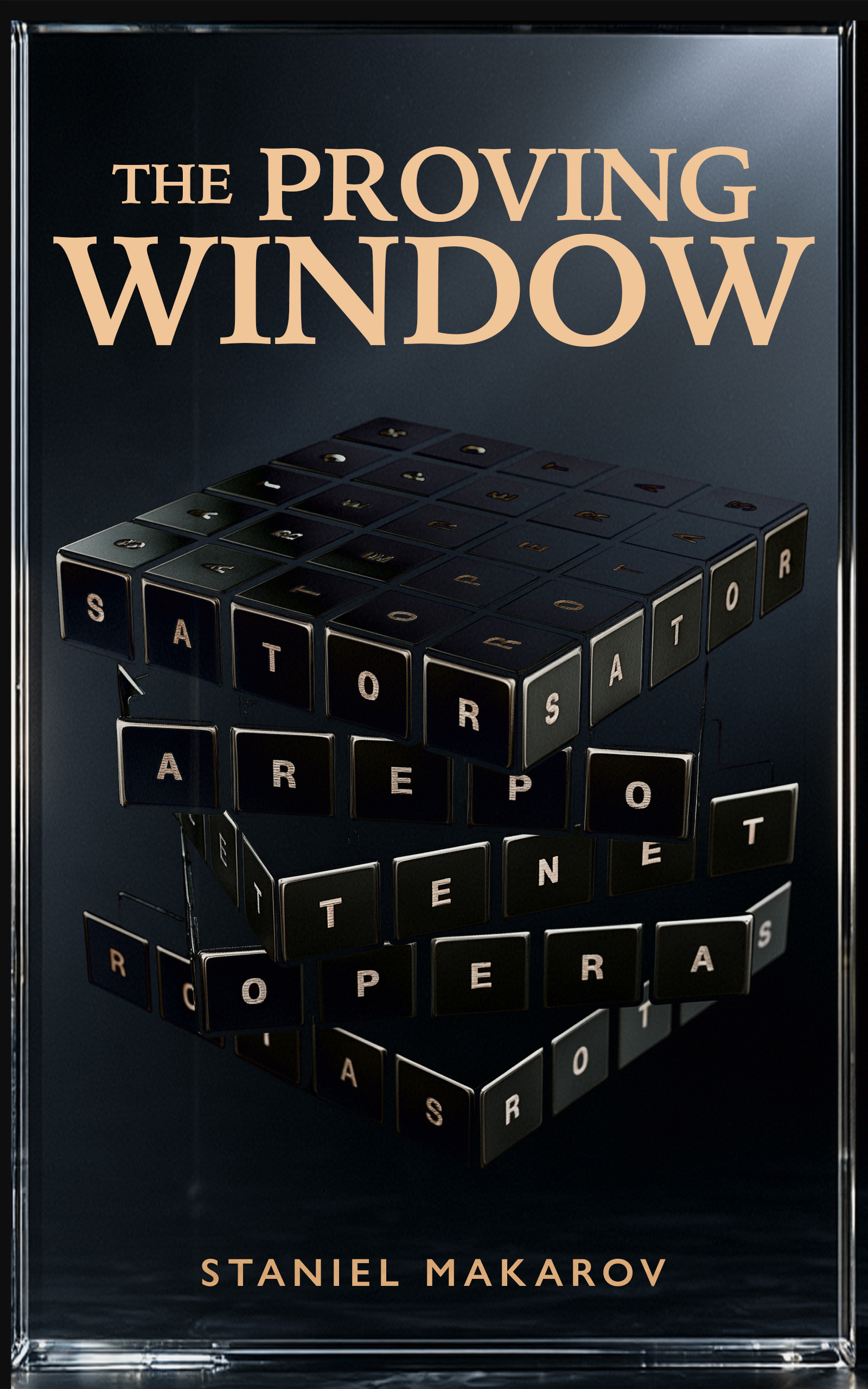
The cover above gives the pattern physical depth, breaking a flat arrangement into separate planes. As a visual analogy, it suggests something useful about rereading: a familiar structure can reveal another relationship when our position changes.
That does not make every repeated detail a secret message. A convincing interpretation should distinguish a pattern that shapes the work from a coincidence that happens to fit an attractive theory. The test is whether the reading helps us see more of the film, with fewer exceptions.
Returning is part of reading
A second viewing is not merely a chance to catch what we missed. Knowledge changes the weight of what was visible all along. A movement can become an intention. A meeting can acquire a history. An apparently isolated image can become part of a relationship.
Tenet makes this ordinary feature of film viewing unusually explicit. We proceed through time while continuously revising the past. Understanding arrives late, but its lateness is not outside the work. It is one of the things the work asks us to experience.